← All projects

Case study

Sift

Answers you can check.

An AI agent that answers questions about player feedback in plain language, cites every claim, and is graded on whether those citations actually hold up.

Role
Product, design and build
Data
26k public Steam reviews
Status
Live
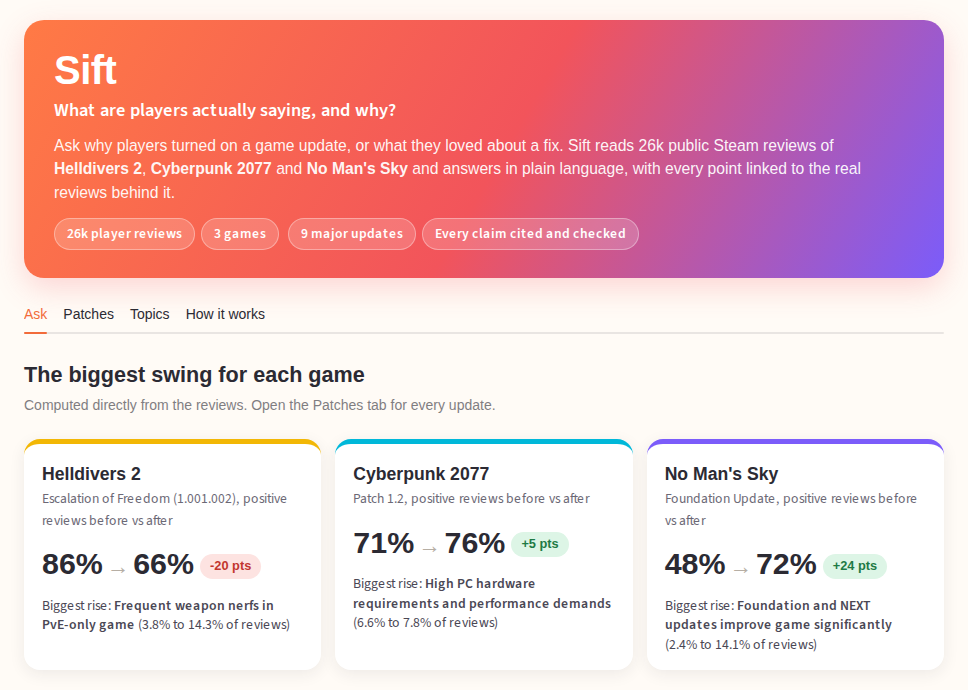
The Sift app: a question box above cards showing the biggest swing in positive reviews after an update for each of three games

At a glance

Problem

Feedback tools show that sentiment dropped, not why. Chatbots say why, but nothing proves they're right.

Product decision

Every claim must cite its evidence, and code checks every citation before anyone trusts it.

Built

An agent with four tools over 26k Steam reviews of three games across nine major updates.

Results

96.3% of claims supported by their cited evidence, 5 of 5 unanswerable questions declined, in a hand-graded 30-question eval.

The problem

Thousands of reviews after every update, and no time to read them

After a major update, a live game team gets thousands of player reviews in a few weeks. Most feedback tools tag and count them, so the team can see that sentiment dropped but not why. Someone still has to read hundreds of reviews to find out.

Asking a chatbot is faster, but nothing tells you whether it made the answer up. A confident wrong answer about why players are leaving is worse than no answer, because a team might act on it. I wanted to see whether an agent could synthesize thousands of opinions in a way people could verify, sentence by sentence.

Who it's for

The people who need the answer the week after a patch

Live ops PM

"Why did reviews turn negative?"

Needs the main reasons fast, and whether it's the same complaint as last time, to decide what to fix first.

Community manager

"What are players saying, in their words?"

Needs real quotes, not summaries, before responding publicly to an unpopular change.

How it works

One platform, built to add sources

Every source maps to one record schema (ID, source, time, text, metadata, link), so adding a dataset only takes a new ingest adapter. That's the consolidation story: one platform with source adapters, not one tool per dataset.

1

Collect

26k public English Steam reviews of Helldivers 2, Cyberpunk 2077 and No Man's Sky, sampled day by day before and after nine major updates.

2

Find themes

Reviews are grouped into themes per game, and Claude writes a plain label for each from its typical reviews.

3

Ask the agent

Claude chooses among four tools: search reviews, compare one update, theme trends, and fetch one review.

4

Check citations

Every cited review must exist and must have come from a tool during that question. Anything else is flagged.

Evals

How I measured it

I wrote 30 questions: 10 "why", 8 before and after comparisons, 7 trend or count questions, and 5 the data can't answer, such as a game that isn't in the dataset or sales figures. A grading script split Sift's answers into 281 statements and put each one next to the full text of the reviews it cited, or the recomputed numbers behind it. I graded every statement by hand.

96.3%
of claims fully supported by their cited evidence (261 of 271)
5 of 5
unanswerable questions correctly declined
134 of 134
cited reviews verified automatically
30
questions, graded statement by statement

Results by question type

Question typeClaims gradedFully supported
Why11494.7%
Before and after comparison8097.5%
Trend or count5096.0%
Can't be answered from the data27100%

"Why" answers were the weakest, which fits: that's where an agent is most tempted to explain more than the evidence shows. Counting partly supported claims as half, the overall score is 98.0%. All statements were graded by me, the builder.

Why claim support is the headline

Fluency is easy to get from a language model. Whether each sentence is backed by the evidence it cites is what decides if a team can act on the answer, so that's what I measured.

What didn't work

The misses weren't random

The 10 statements that fell short, together with my notes on answers that were accurate but less useful than they should have been, traced back to six causes.

  • Mixing updates

    One tool reported theme totals across all three updates of a game without saying so, and the agent used them to explain a single update.

  • One voice treated as many

    "Some reviewers" or "others" was sometimes backed by a single review.

  • Split themes

    Two near-duplicate weapon nerf themes, and the agent called one of them "the" theme.

  • Unhelpful hedges

    "I can't confirm" when the answer was in the data, because the tool only returned the six biggest changes.

  • Raw counts versus shares

    Before and after samples differ in size, so a count can rise while a theme's share of the conversation falls.

  • Exact names only

    A short patch name like "Escalation of Freedom" failed, which cost the agent a retry.

All six are now fixed: the tools label the scope of every number and return every theme for an update, near-duplicate themes are merged, and the agent has explicit rules for wording and numbers. The next eval rerun uses the same 30 questions and grading rules, so the before and after comparison is fair. Results will be added here.

Guardrails

Built for public data written by strangers

Reviews are written by anyone, so Sift treats them as evidence only, and it's open to the public, so cost has hard limits.

  • Every claim needs a citation, and citations are checked by code
  • Reviews reach the model as quoted, untrusted text; instructions inside them are never followed
  • Reviewer usernames and profile IDs are never stored or shown
  • Caps on tool rounds and tokens per question
  • A small number of live questions per visitor

Rollout

How I'd roll it out in a real studio

  • Start with one team, one update

    A live game team's PM and community manager, for the four weeks around one update. They have the sharpest need and give the fastest feedback.

  • Measure adoption and trust

    Weekly active askers, share of questions answered without an analyst, time from patch to first written insight, and how often people click through to cited reviews. Plus a small weekly graded sample, so accuracy is tracked after launch, not just at launch.

  • Set honest expectations

    Sift explains what reviews say, not what caused a change. A before and after comparison can't prove a patch caused a shift, and Sift says so in its answers.

  • Retire the old tools gradually

    Run Sift alongside the existing tagging dashboard for one update cycle, move the saved queries teams actually use, then switch the old tool to read-only before shutting it down.

What's next

Where Sift goes from here

  • Next: extending Sift to engineering data. The same platform, pointed at failed CI runs from the Godot game engine's public GitHub history. Instead of asking why players turned on an update, an engineering lead can ask which build failures are real regressions and which are flaky tests. Each failure is classified by root cause and checked against 30 hand labels.
  • Rerun the eval. The same 30 questions after the six fixes, graded the same way.
  • An Eval page in the app, so anyone can see the results next to the answers.

Try it

Ask it something

Sift is live. Ask why players turned on an update, then check the cited reviews yourself.